The New European Bauhaus (NEB) is an initiative launched by the European Commission in 2020, inspired by the Bauhaus movement of the early 20th century. Its aim is to fuse sustainability, aesthetics and inclusivity to create living spaces that respond to today’s environmental challenges while being beautiful and functional.
What is NEB?
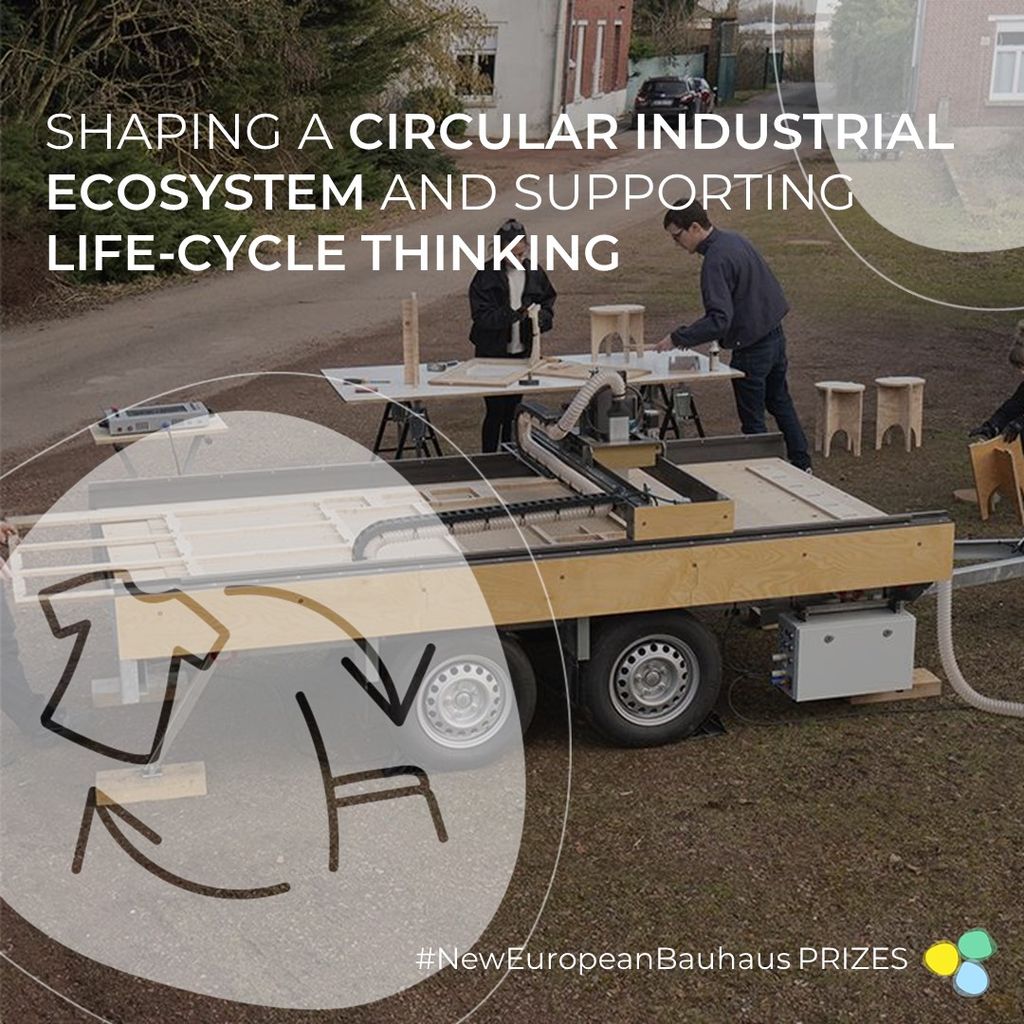
NEB aims to transform our societies by integrating sustainable solutions into our built environments. NEB is not limited to architecture or urban planning: it is a creative and transdisciplinary movement that encourages innovation and collaboration between artists, designers, engineers, scientists and citizens, and which explicitly recognises the role of designers (product, spatial, furniture, scenography, materials and services) as key players in transforming lifestyles and built environments.
The NEB supports projects that make the green transition enjoyable and accessible to everyone, with a focus on cultural diversity and local needs.
How is it funded?
As a cross-cutting initiative, funding comes from several European Union programs, including :
- Horizon Europe : This EU research and innovation program supports NEB’s “Research and Innovation” strand with an annual budget of 120 million euros.
- other EU programs (i.e. Cohesion policy, LIFE programme): NEB’s deployment component draws on support from other EU programs to fund solutions for transforming the built environment.
These mechanisms enable NEB to support a wide range of projects, from basic research to practical implementation, as well as local and community initiatives.
Recommendations for designers in Wallonia-Brussels
In response to the New European Bauhaus calls for proposals, designers in Wallonia-Brussels would be well advised to adopt a strategic approach: rather than searching for calls “for designers”, they should identify projects where their expertise is essential (usability, spatiality, aesthetics, circularity). The NEB values collaborative and contextual approaches, in which design plays a key role alongside local authorities, researchers and social actors.
Thanks to their culture of human-scale projects, formal restraint and the local roots of their practices, Belgian designers are particularly well-positioned to integrate as creative partners within European consortia and gain international visibility.
What’s in it for designers and creators ?
For a Belgian fashion designer or creator, the NEB offers several advantages:
- access to ressources : NEB offers tools and advice for integrating sustainable practices into design: training courses, workshops and practical guides.
- visibility and networking: Participating in NEB projects can provide a platform for showing your work to a European and international audience, or for collaborating with other professionals from different fields.
- financial support : NEB offers funding opportunities for innovative projects that align sustainability and aesthetics to bring to fruition more ambitious projects that would otherwise have been limited by budget constraints.
How to find financing?
- Official Site : The NEB website provides information on (ongoing and future) calls for projects and available funding opportunities, with details of eligibility criteria and submission deadlines.
- Taking part in events: NEB organizes regular events and information sessions.
- Networking: Joining networks and communities of professionals involved in NEB can help to find partners for subsequent projects and access information on available funding.
- Draw inspiration from existing projects: before responding to a European call for proposals, consult the projects and resources listed on NEB Junction and NEB Gems. This research will help you identify approaches that have already been tested, avoid reinventing existing solutions, and gain a better understanding of the expectations of the European ecosystem.
Which financing?
The New European Bauhaus is now supported by the NEB Facility, a cross-cutting European Union instrument aimed at accelerating the sustainable and inclusive transformation of our living environments. This new phase draws in particular on Horizon Europe and funds collaborative projects bringing together research, innovation, culture, design, architecture, local authorities and civil society.
The Horizon Europe 2026–2027 work programmes include new calls for proposals relating to sustainable neighbourhoods, building renovation, the reuse of vacant spaces, territorial resilience and the ecological transition of the built environment. Designers, architects and professionals from the creative industries have a vital role to play in these consortia as experts in usability, aesthetics, circularity and user experience.