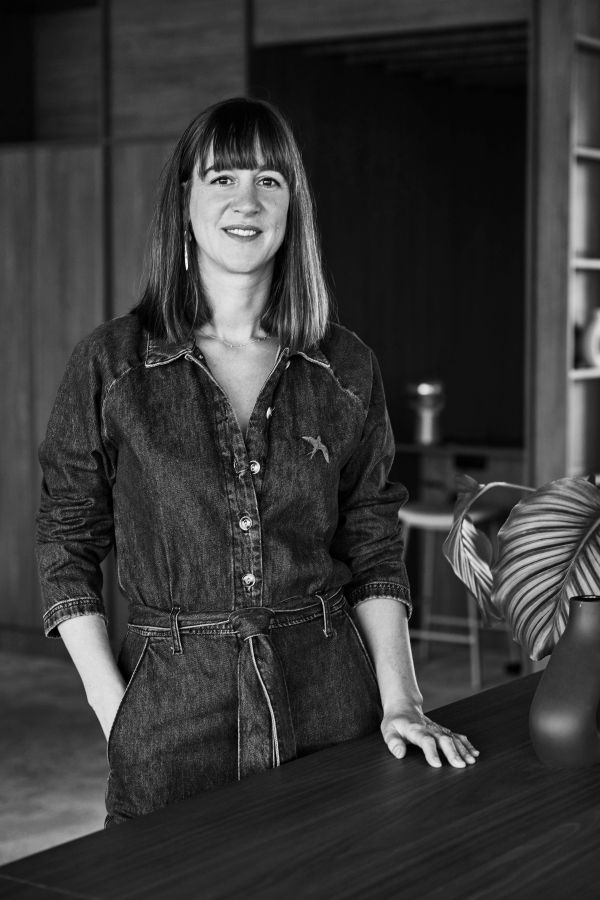
Exactly ten years ago, Charlotte Lancelot won the Red Dot Design Award for a collection of rugs developed for the Spanish brand GAN rugs. This accolade, one of many she has received since the beginning of her career, now joins her title of Designer of the Year. She describes her work as a source of joy and shares her vision of objects that go beyond their practical function
What does this ‘Designer of the Year’ title mean to you? Is it a crowning achievement, a responsibility or a new stage in your life?
Some of all of that, but first and foremost it’s the joy of being recognised. An award is inevitably a form of validation – recognition of my work by key figures in the design world. This implies that this work has the potential to make an impact on society. However, having an impact entails a responsibility.
‘Responsibility’: a word that signifies a commitment. What do you mean by that?
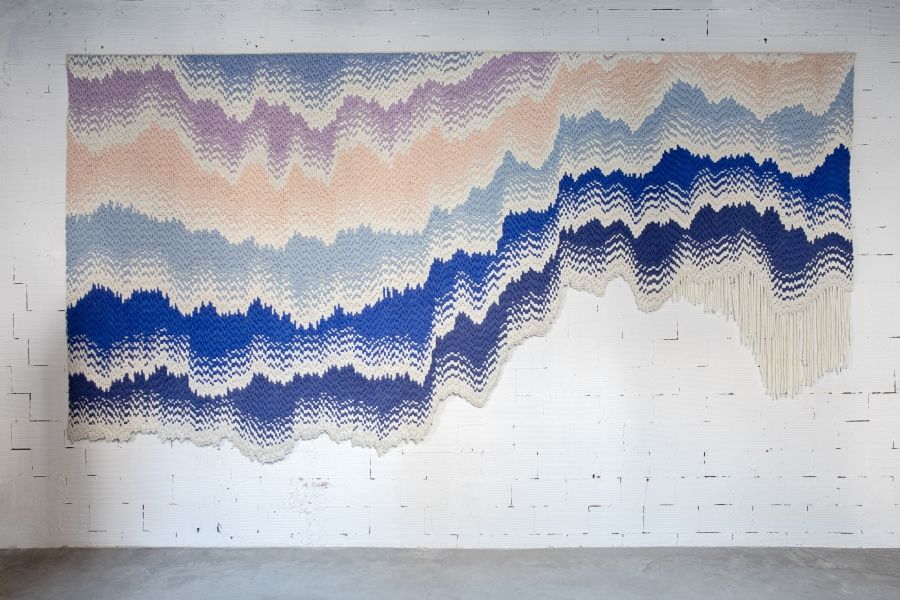
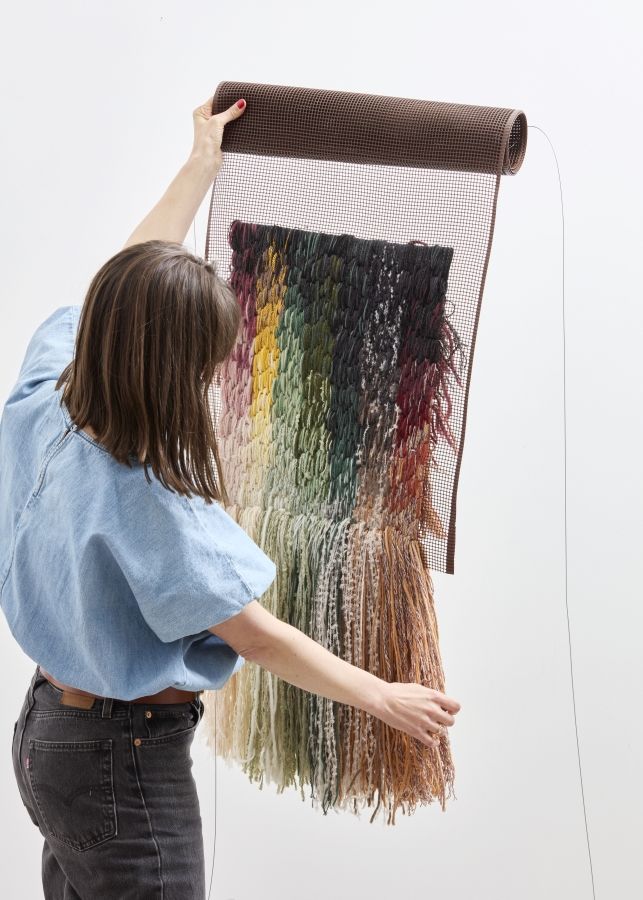
Design is often reduced to an object, whereas it is actually a system that takes various parameters into account, including context, the possibilities offered by the material and users’ needs. My approach always stems from a problem that needs solving. I use the systemic design methodology to create a product that meets a wide range of criteria. For Onda, one of my most recent projects, I chose to rethink the way we view tapestry by reinventing the concept of embroidery on a very large scale. Because this technique involves simple gestures, it highlights traditional skills that are familiar to everyone.

Onda addresses a need to reconnect with nature in the age of artificial intelligence, through contemplative and immersive tapestries that evoke a great wave or the strata of the earth. They highlight manual craftsmanship in a world that is becoming increasingly digital. I use simple embroidery techniques, such as cross-stitch, traditionally associated with the domestic and feminine spheres. By altering their scale and function, I seek to shift the way this craft is perceived and to give it a new place within contemporary design.
Tell us about your Landscape project and, more specifically, the tapestry Sea Foam.
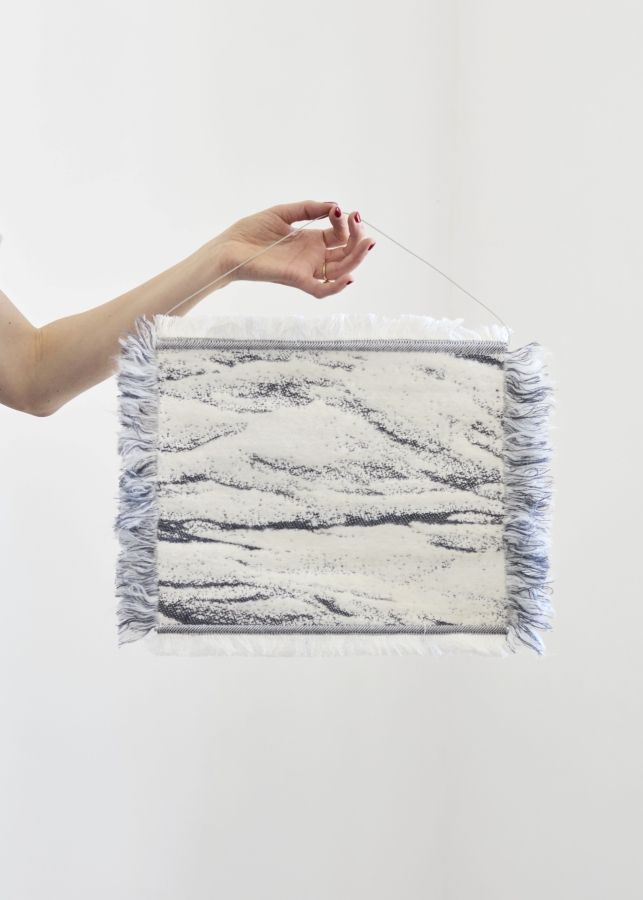
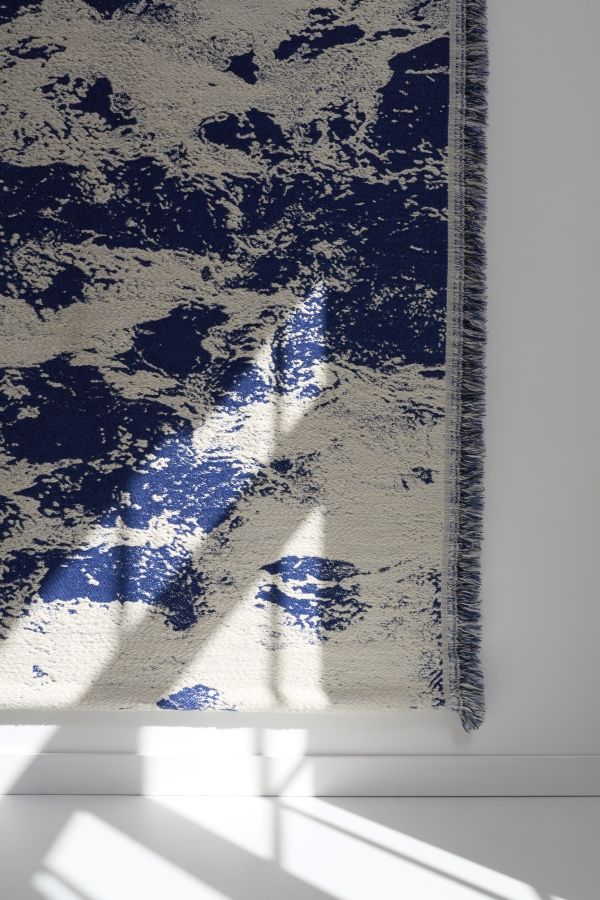
Usually, when creating a jacquard-woven tapestry, you design the pattern and order more yarn than you need to ensure you have enough. This yarn then accumulates in the factories. But as factories are designed to produce standardised products, my question was: how can we reintroduce different yarns into a system that demands all products be identical? So I devised a system of textile photocopying, where the ink is the thread. It is the thread that determines how the design is interpreted by the material. The size of the tapestries depends on the resources available, and not the other way round. Designing means creating an object, but it also sometimes means changing the narrative.

You studied industrial design. Now, your work lies somewhere between craftsmanship and industry. What was the starting point for your thinking?
My work involves observing, listening and understanding before testing out solutions. My aesthetic is simple, but behind this simplicity lies a reflection on our culture, our ways of producing and consuming. My aesthetic stems from a specific process. I try to strip away everything superfluous to create a piece that is both timeless and yet original and unique. The starting point is always a problem to be solved, whether it concerns usage, production methods or the need for innovation, communication, pricing strategy or the system itself.
At a time when design is striving for ever greater sustainability, what role does the concept of beauty still play?
I like to draw inspiration from nature. For me, design should be a source of wonder and joy. Our responsibility as designers is to find solutions, and for those solutions to result in objects that tell stories. I’ve thought a great deal about my need to create beautiful objects. I believe that wonder and joy are important in building society, as they enable us to find common ground. I also think that beauty helps to make a story appealing.

In a long-standing career, there is often a decisive turning point. What was yours?
I studied industrial design at La Cambre in Brussels, but I’ve always had an affinity with textiles; I even considered studying fashion. After completing my degree, whilst preparing for a trade fair, I discovered — rather by chance — strips of felt with holes in them at a factory, which were due to be recycled — a process that partially alters the nature of the material. So I decided to salvage them, then stitch them together to make rugs. My first prototypes caught the eye of the Spanish brand GAN, which saw potential in these pieces. Whatever I set out to do, I need to understand the tools I use to make things.

Silaï, your collection for GAN — which won the Red Dot Design Award — hasn’t aged a bit. What is a design that stands the test of time?
It’s a design that resonates with people because it draws on a shared experience. My inspiration isn’t tied to trends, but to the little details of life that move us and connect us to a shared heritage. Like the sky or a sunset, which symbolise shared experiences. It is these symbols that connect us and enable us to form a society. In the case of Silaï, it is an embroidered collection that also reconnects us with ancestral traditions and shared experiences. The collection is composed like a patchwork, using different types of stitches. The colours are inspired by cement tiles, a typical feature of Brussels homes. The colours are intense but muted so as not to strain the eyes. I use references that are as universal as possible, as they are not tied to fleeting trends.

At what point does an experiment cease to be one?
Only 10% of my ideas become products. In 2026, we cannot afford to overproduce or launch products that serve no purpose. What I offer must be truly unique. I need each project to have had time to mature, but when the materials, production techniques and clients… all come together, the music is harmonious. Joy sets in and I know I’m on the right track.
And this collaboration with GAN: you could call it a genuine mutual loyalty.
Whilst this collaboration has lasted for years, to the point where it has become the backbone of my creative thinking, I feel completely free to be myself. I like to talk about a sense of continuity that doesn’t stop me from putting everything into play with every project. One thing is certain: I put a great deal of myself into each of these collections.
What remains for you to explore? Materials? Ways of approaching design? A collaboration?
At GAN, they call me ‘the Project Machine’; I’m never short of ideas! Naturally, I want to continue this collaboration. I also want to continue exploring and asserting my creative vision. Two themes run through my work: on the one hand, the reinterpretation of our traditional and artisanal skills, through collaborations such as those with GAN or Pinton; on the other, contemporary issues relating to raw materials, reuse, local production and the accessibility of quality objects.
I also want to broaden the scope of my creative expression beyond textiles, as I have done with the cement tiles for Maison Bahya. The exhibition Personal Structures in Venice, to which I was invited to contribute, has also inspired me to explore a more artistic medium, one that allows me to address, more freely, questions relating to our existence, our relationship with the world and the search for meaning. For me, design is, above all, a means of finding practical, creative and desirable solutions to contemporary challenges. What drives me is imagining things that do not yet exist, but which could change the way we live, produce or think. That is where design comes into its own.